Categories
Bookkeeping

How to Write a Receipt A Complete Guide for Businesses

However, it can quickly become overwhelming if you need to fill out multiple receipts in a day. In the U.S., both digital and paper receipts are accepted for IRS compliance, as they are both clear and legible. Business owners should store these receipts for at least 3 to 7 years, depending on the expense type. Last, but not least, ensure to follow proper security measures like encryption and backups to avoid any data loss. Also, add the receipt number to track the sales throughout the day.

You may then choose to send the invoice directly to your customer through email or other messaging platforms from the app. Or, you may save it to your preferred cloud storage provider, then download the receipt in PDF. Receipts are essential documentation for bookkeeping and filing tax returns, so make sure to keep copies of them safely and in an organized manner. Integrating your receipt system with your accounting system can save you time and reduce errors. By automating the process of entering data into your accounting system, you can reduce the risk of mistakes and free up time to focus on other tasks.

Sales receipts come in handy to track the products or services that are mostly purchased by your customers. With this information, you can customize your services to meet the specific requirements of your targeted customers. After everything has been totaled, write down the method of payment. If you are paid by cash, include the cash amount and any money returned. Whether receipts are used for inventory management, accounting purposes, reimbursements, or tax calculations, using premade receipt templates makes sense. Customizable receipt templates mean you don’t have to start from scratch every time.

Table of Contents

More businesses prefer sending receipts through email because it’s practical—both in terms of time and money. If you prefer a more hands-on approach, you can create a receipt manually. This method requires a bit more effort, but it allows you to customize the receipt to your liking.

Step 3: Add organization name and contact details

A receipt follows, confirming the payment was made and finalizing the transaction. Follow these 8 important steps to create clear and professional receipts that build trust and simplify accounting. Now that you have understood the major differences between sale receipts and invoices.

A professional-looking receipt ensures transparency and also acts as proof of transaction in future business operations. If a customer needs to return an item or file a warranty claim, they will need to provide proof of purchase. A receipt is the best way to do this as it contains all the necessary information, including the date and time of the transaction, the items purchased, and the amount paid. Spark Invoice will instantly generate a well-formatted, professional how to write a receipt invoice in PDF.

But it also shows your clients you’re dependable and committed to a 5-star customer experience. Should an error occur while filling out a receipt, prompt correction is necessary. For minor errors, such as a misspelled name or incorrect date, simply draw a line through the incorrect information, write the correct details above, and initial the correction. This ensures that the receipt remains accurate and trustworthy while maintaining a professional appearance. Customers should be able to read and understand the details of their transaction easily, so always write clearly and legibly. Additionally, ensure that your calculations are accurate, double-checking the subtotal, taxes, and grand total to avoid discrepancies and potential disputes.

It is important to ensure that your template includes space for a unique receipt number and any other information specific to your needs. The transaction details section should include a list of the items or services purchased, along with their prices and quantities. This information should be clearly organized and easy to read, with subtotals for each item and a total for all items combined. If applicable, any discounts or taxes should also be included in this section.

Handover the original receipt to the customer via mail and have an extra copy of the receipt for your records. Additionally, business owners should add the business’s tax identification number (TIN) to ensure proper tax reporting. Following these legal regulations confirms the transparency and compliance with legal standards. Furthermore, receipts can help businesses identify trends in customer behavior and preferences.

Steps to Writing a Payment Receipt

However, regardless of the structure, receipts usually contain the same information. For more information on how to write a receipt, visit The Balance Small Business. Recording the date when the transaction occurred can help ensure you have the proper evidence if a dispute arises. For example, you can confirm a buyer’s right to return an item within a certain number of days.

By providing a receipt to your customers, you are not only fulfilling a legal requirement, but you are also establishing trust and credibility with them. For more information on how to create a receipt, check out this helpful guide. Legal Templates LLC is not a lawyer, or a law firm and does not engage in the practice of law. Legal Templates cannot and does not provide legal advice or legal representation.

  • Ross picked Company B, and just a day after, company B sent him an invoice showing the items included in the package, along with their price.
  • With a professional-looking receipt, you can streamline the entire business process.
  • Customers who make payments for goods and services retain receipts as proof of their payment.
  • Overall, it is important to ensure that your receipts are legally compliant and meet all necessary requirements.
  • However, it offers several additional benefits, such as the ability to tailor your documents fully without opening another document editor.

Looking for Downloadable Invoice Templates?

It is essential to ensure that this information is accurate and up-to-date. Besides saving tons of time, using standardized receipt templates helps reduce manual errors. Businesses can choose from different receipt templates to suit their needs and purpose. You can use them on job sites where Wi-Fi isn’t exactly reliable or for customers who prefer physical documents. You can use a pre-printed receipt book or handwrite a simple receipt with all the key details. A receipt of payment is an important piece of financial documentation for contractors.

  • Every approach to making receipts we’ve discussed so far has its merits.
  • Furthermore, a carbon copy separator should be placed behind the yellow page to complete the receipt.
  • A professional receipt adds to the transparency of the transaction, which leads to building customer trust.
  • This includes the payment method used, such as cash, credit card, or check, and the total amount paid.

Receipts are always necessary in a business, no matter how large or small. Personal transactions, such as selling a car to a friend, require a receipt as well. Should anything go wrong, there is proof of when the transaction occurred and how much the seller was paid, along with the method of payment.

Receipts are important for both individuals and businesses in the tax season. It enables to ensure that all the transactions are accounted for properly in the financial statements. With the help of accurate receipts, you can easily handle sales tax calculations and ensure compliance with IRS regulations. Save time as an entrepreneur or small business owner, by creating smart branded receipts with our free receipt templates. Download, add your business information and the payment details, and you’re done. Effective financial management requires vigilant tracking of your sales and payments.

Categories
Bookkeeping

Hurdlr vs Quickbooks Bookkeeping Services Made For Entrepreneurs

In addition, the features seem to be well thought out. When deciding between Hurdlr vs QuickBooks, consider the specific needs of your business. Both solutions offer free trials so take advantage of that opportunity before making a final decision.

Simplify Startup Finances Today

The overall cost may increase as your business scales and requires more comprehensive functionalities. Hurdlr doesn’t offer any integrations at the moment, but they plan to in the future. They are currently working on some great integrations with other apps, including Quickbooks. This may give you the best of both worlds without having to choose between the two.

The premium plan is affordable for tax calculations. Its higher cost reflects its extensive capabilities. Consider what features are essential for your business. Compare them with the costs to decide which software offers the best value. With QuickBooks, you can easily track your income and expenses, create professional invoices, manage inventory, and generate detailed reports. The software also integrates with various banking institutions, allowing you to automatically import transactions and reconcile accounts effortlessly.

Hurdlr Vs Quickbooks: Which Is Best for Your Business?

Yet, for those who want detailed analytics, QuickBooks might be worth the learning curve. Setting up your financial tracking software should be straightforward. Hurdlr shines with its quick, intuitive setup that gets you going in minutes. You simply download the app, connect your accounts, and start tracking your expenses.

Sales Tax Features

There are plenty of options on the market regarding accounting software. Before choosing Hurdlr or Quickbooks, you may want to look at some of these alternatives. These features are all great, but I think the most helpful feature of Hurdlr is that it allows for 100% customized deductions. This means that you can track anything you need to, even if it isn’t automatically tracked. In addition, you can set up as many unique deductions as your business needs.

  • SoftwareSuggest offers verified & unbiased user reviews based on user ratings and feedback.
  • Hurdlr and QuickBooks both offer financial management tools but cater to different needs.
  • As a result, it’s easy to find your way around the program, and it doesn’t take too long to learn what everything does.

Only Hurdlr provides mobile in-app chat, and our user reviews often speak highly about our customer service. Hurdlr provides 24/7 live mobile chat support, which is particularly useful for users who need quick answers while on the go. Customer reviews often highlight the responsiveness and effectiveness of its support team. Check out our growing YouTube channel where we go deeper into the digital tools and share more of our personal experiences growing our businesses. As a result, it’s easy to find your way around the program, and it doesn’t take too long to learn what everything does.

Real Estate Accounting Features

Choosing the right software can make or break your efficiency. Another great feature of QuickBooks is its ability to integrate with other business applications such as CRM systems and e-commerce platforms. This integration allows for seamless data transfer between different systems, saving time and reducing manual data entry errors.

Many people like it because you can use it with just one other collaborator. It also has a lot of integrations, so you can connect it to other apps that your business uses. The downside is that it’s only available online, and it doesn’t provide information on your income for tax time, which you might need if you’re a freelancer or employee. Freelancers and contractors need straightforward expense tracking. It offers real-time tax estimates and invoicing features. QuickBooks also serves freelancers with its Self-Employed version.

Which mobile platforms do QuickBooks Online and Hurdlr support?

  • QuickBooks is a popular accounting software that has been trusted by millions of businesses worldwide.
  • However, there are also some drawbacks to consider when using Hurdlr.
  • The downside is that it’s only available online, and it doesn’t provide information on your income for tax time, which you might need if you’re a freelancer or employee.
  • With its real-time insights and automated features, Hurdlr can save you time and effort in managing your financial records.

Quickbooks is pretty similar to Hurdlr’s design, but it has more features. Unfortunately, it’s more expensive than Hurdlr, and it charges a monthly fee for the use of its software. Nevertheless, it’s a great option for people who want a more professional feel and have the budget for it. Hurdlr offers a free version and paid plans starting at $8 per month. Visit Hurdlr’s website for detailed pricing options and to choose a plan that fits your needs. Hurdlr provides integration with popular platforms like Uber and Square.

It offers a range of features and tools to help streamline financial management tasks, making it an essential tool for small and medium-sized enterprises. As your business evolves, so will your accounting needs. Many entrepreneurs start with simpler tools like Hurdlr and later transition to more complex systems like QuickBooks as their operational requirements increase. Choosing between Hurdlr and QuickBooks depends on your needs. Hurdlr is great for freelancers and small businesses. QuickBooks suits larger companies with complex accounting.

QuickBooks offers phone, chat, and email support within extended business hours. It also has extensive online resources, a vast network of third-party accountants, and numerous tutorials. However, some users report that QuickBooks support can be slower during off-hours. In contrast, QuickBooks requires a monthly subscription starting at approximately $25 per month, with tiered pricing for additional users and advanced features.

The downside is that there’s no way to organize business-related expenses, and you could end up wasting a lot of time manually entering data. Comparing Hurdlr and QuickBooks, security and privacy are crucial considerations. Hurdlr prioritizes user data protection with robust encryption hurdlr vs quickbooks protocols.

In the higher-tier packages, QuickBooks provides inventory tracking and project management tools that are useful for businesses dealing with physical products and complex projects. When selecting a financial tool, it’s important to consider the size and complexity of your business. Freelancers often prefer tools that are easy to use and don’t require extensive accounting knowledge. On the other hand, small businesses with multiple revenue streams may need more comprehensive features like inventory management and multi-user access. QuickBooks is a popular accounting software that has been trusted by millions of businesses worldwide.

It helps you file your taxes in a way that makes sense, which is great for people who are new to filing their own taxes. In short, I would say that Hurdlr is better for people who don’t want to pay a monthly fee. It’s also better for people who want a more comprehensive deductions feature. It’s a great option for people looking to manage their books on their own and get more of a sense of ownership/control over their money. It feels more like a startup than Quickbooks, and it’s an exciting platform.

Categories
Bookkeeping

Managing Small Business Finances: What to Focus On

managing small business finances

Let’s look in more detail at the differences between each of these financial tasks, why you need them, and how to manage them in a way that’s right for your business. Sometimes, raising prices can, counterintuitively, increase sales by conveying quality. Plus, having an accurate payroll system helps you stay compliant with employment regulations and build trust with your employees, so they know they’re being paid correctly and fairly. Regularly reviewing these reports can also help you make informed decisions about where to invest and where to cut back. This is where a reliable and secure payment processing system comes into play.

Accessible and transparent reporting builds trust and confidence among stakeholders, contributing to the overall credibility and reliability of the business. In the early business stages, especially, cashflow poses a challenge. Initial expenses often outweigh incoming revenue when clients or customers aren’t yet established. It’s vital to assess your cashflow right from the start and secure temporary financial sources like savings or overdrafts to sustain operations until revenue streams begin. Maintaining a state of ‘positive cashflow,’ wherein your income exceeds your expenses, is crucial for sustaining your business operations.

Pick a method of accounting

Depending on where you live and the type of business you run, there might be other records you’re legally required to keep or additional tax forms you need to file. Talk to a CPA at the beginning of your tax year to get a clear idea of how best to maintain your records. When you outsource your bookkeeping, you can hire a freelance bookkeeper, a bookkeeping firm, or an online bookkeeping service. Depending on how big your business is and how complicated your financial needs are, you have a couple of options for how you handle your bookkeeping. the most important info about accounts payable process If your business is still more of a side hustle, or if its finances are simple, you likely can skip enlisting the help of a CPA for now. There are plenty of small-business finance resources online you can reference.

If you’re lost when it comes to proper accounting and business funds or resource management, you might find yourself unable to invest in or grow your business. To build your business credit, start by registering for a free DUNS number through Dun & Bradstreet. Use your DUNS number when applying for business credit cards or trade credit accounts. Then make on-time payments to show business credit bureaus that you’re financially responsible.

Learn why cash flow is vital to your business, how to create a cash flow forecast, and how terms like burn rate and cash runway impact your business. If you don’t do a financial review at least once a month, you’ll struggle to understand your business’s performance, and growth will constantly be out of reach. There are many benefits to accurate financial reporting — from gaining a better understanding of the current state of your operation to attracting investors and securing funding for growth. It should encompass short-term and long-term goals, expense projections, and strategies for revenue generation. Moreover, financial reports aid in demonstrating the company’s financial position to stakeholders, including investors, lenders, and potential partners.

managing small business finances

Creating and reading financial statements

Now that you know why you need to stay on top of your bookkeeping, let’s look at how to do it. Monitoring your books lets you see in real time what’s working well and what needs tweaking. Online shoppers expect to see a shipping charge added at the end of their purchasing process, but keep this cost reasonable. Customers faced with an exorbitant shipping cost may very well abandon their cart and not come back. Both strategies are reasonable, but there are other ways small business funding works.

How to get started with bookkeeping as a business owner

The Small Business Association (SBA) partners c corp vs s corp partnership proprietorship and llc with lenders to give small business loans to small business owners. It sets the guidelines for it’s small business loans made by its partners. The SBA helps small business owners who struggle to get approved for other loan programs. Keep in mind that not all credit card companies and vendors report payments to the business credit bureaus. If you’ve been making on-time payments and they haven’t been submitted, consider signing up for Dun & Bradstreet’s CreditBuilder product.

They may face bureaucratic hurdles and slower decision-making processes. With dedicated risk management teams and robust how to calculate straight line depreciation formula insurance coverage, larger corporations have more resources to manage potential financial threats. Understanding these differences is vital for effective financial management in both small businesses and large corporations.

  1. This can come in handy with hiring another employee or an independent contractor.
  2. It’s more complicated than single entry, but it provides more information about your business.
  3. You may qualify for the ERC if you own a small business or tax-exempt organization that continued paying your workers from March 13, 2020, to December 31, 2021.
  4. Sometimes, raising prices can, counterintuitively, increase sales by conveying quality.

Everything you need to know about cash flow

Companies may also report your payment information to other credit bureaus too, namely Experian Small Business and Equifax Business. If you want to secure financing for your business at some point in the future, keeping your books up to date can help bolster a loan application or investment pitch. Well-managed finances and clear records allow potential lenders and investors to make realistic projections of your company’s financial health and give them confidence to invest in you.

Cash-flow statements show you how much cash your business has earned or used during a specific time period. If you’re using the cash accounting method, you can already see how much cash you have available. They’re a great way to check in on how your business is doing, make predictions about upcoming revenue and expenses, and decide when to invest in growing your business.

Categories
Bookkeeping

Accounting Equation Overview, Formula, and Examples

assets equation

An error in transaction analysis could result in incorrect financial statements. An accounting transaction is a business activity or event that causes a measurable change in the accounting equation. Merely placing an order for goods is not a recordable transaction because no exchange has taken place.

Which three components make up the Accounting Equation?

For example, if a company takes on a bank loan to be paid off in 5-years, this account will include the portion of that loan due in the next year. This line item includes all of the company’s intangible fixed assets, which may or may not be identifiable. Identifiable intangible assets include patents, licenses, and secret formulas. Balance sheets, like all financial statements, will have minor differences between organizations and industries. However, there are several “buckets” and line items that are almost always included in common balance sheets. We briefly go through commonly found line items under Current Assets, Long-Term Assets, Current Liabilities, Long-term Liabilities, and Equity.

Accounting Equation

After six months, Speakers, Inc. is growing rapidly and needs to find a new place of business. Ted decides it makes the most financial sense for Speakers, Inc. to buy a building. Since Speakers, Inc. doesn’t have $500,000 in cash to pay for a building, it must take out a loan. Speakers, Inc. purchases a $500,000 building by paying $100,000 in cash and taking out a $400,000 mortgage. This business transaction decreases assets by the $100,000 of cash disbursed, increases assets by the new $500,000 building, and increases liabilities by the new $400,000 mortgage. The asset equals the sum of all assets, i.e., cash, accounts receivable, prepaid expense, and inventory, i.e., $234,762 for 2014.

Accounting Equation Example

These equations, entered in a business’s general ledger, will provide deducting business expenses the material that eventually makes up the foundation of a business’s financial statements. This includes expense reports, cash flow and salary and company investments. The fundamental accounting equation, also called the balance sheet equation, is the foundation for the double-entry bookkeeping system and the cornerstone of the entire accounting science. In the accounting equation, every transaction will have a debit and credit entry, and the total debits (left side) will equal the total credits (right side).

  1. The equation is generally written with liabilities appearing before owner’s equity because creditors usually have to be repaid before investors in a bankruptcy.
  2. However, there are several “buckets” and line items that are almost always included in common balance sheets.
  3. This straightforward relationship between assets, liabilities, and equity is considered to be the foundation of the double-entry accounting system.
  4. It is based on the idea that each transaction has an equal effect.

If depreciation expense is known, capital expenditure can be calculated and included as a cash outflow under cash flow from investing in the cash flow statement. This account includes the total amount of long-term debt (excluding the current portion, if that account is present under current liabilities). This account is derived from the debt schedule, which outlines all of the company’s outstanding debt, the interest expense, and the principal repayment for every period. As you can see, assets equal the sum of liabilities and owner’s equity. This makes sense when you think about it because liabilities and equity are essentially just sources of funding for companies to purchase assets. For example, an increase in an asset account can be matched by an equal increase to a related liability or shareholder’s equity account such that the accounting equation stays in balance.

The asset equals the sum to all assets, i.e., cash, accounts receivable, prepaid expense, and inventory, i.e., $305,483 for the year 2018. In this form, it is easier to highlight the relationship between shareholder’s equity and debt (liabilities). As you can see, shareholder’s equity is the remainder after liabilities have been subtracted from assets. This is because creditors – parties that lend money such as banks – have the first claim to a company’s assets. These may include loans, accounts payable, mortgages, deferred revenues, bond issues, warranties, and accrued expenses.

assets equation

As a core concept in modern accounting, this provides the basis for keeping a company’s books balanced across a given accounting cycle. The accounting equation states that a company’s total assets are equal to the sum of its liabilities and its shareholders’ equity. The accounting equation equates a company’s assets to its liabilities and equity.

These are some simple examples, but even the most complicated transactions can be recorded in a similar way. This is the total amount of net income the company decides to keep. Every period, a company may pay out dividends from its net income. Any amount remaining (or exceeding) is added the two types of accounting are to (deducted from) retained earnings.

Categories
Bookkeeping

Exploring Economic Costs: Explicit and Implicit B Com Institute

In turn, this costs the firm however much output that manager would have created had they not needed to train the employees. An explicit cost is any cost that is reported as a separate cost. Explicit costs are tracked within the accounting records, because they involve the payment of cash to third parties. Examples of explicit costs are compensation, rent, and utility costs.

For example, to welcome the new worker and train him to a necessary standard may take the time of the manager, who cannot do other tasks as he trains the new workers. Implicit costs are costs that occur due to a specific path or option being chosen. It represents an opportunity cost when the firm uses resources for one use over another. For example, a manager may need to train their staff, which requires 8 hours of their time. The implicit cost is the cost of their time which could have been employed doing their other daily tasks.

Once all relevant financial documents are collected, businesses can categorize these expenses into direct labor costs, material costs, and overhead expenses. For direct labor costs, this includes wages, overtime, bonuses, and benefits paid to employees directly involved in production. Material costs encompass the expenses for raw materials and components used in manufacturing. Overhead expenses cover indirect costs such as rent, utilities, and administrative salaries. By systematically categorizing and summing these expenses, businesses can determine their total explicit costs. This detailed breakdown not only aids in financial reporting but also helps in identifying areas where cost-saving measures can be implemented.

All these have monetary cost and the transactions will be recorded. The estimated value of the inputs supplied by the owners along with the normal profits is known as Implicit Cost. This is because the existing employee would normally have been working in their regular role, and contributing to revenue earned. For the past 52 years, Harold Averkamp (CPA, MBA) hasworked as an accounting supervisor, manager, consultant, university instructor, and innovator in teaching accounting online. He is the sole author of all the materials on AccountingCoach.com.

  • When looking at a firm’s financial statements, these costs are subtracted from the firm’s revenue to obtain its accounting profit.
  • Let’s suppose that you have decided to start own business (own firm) instead of doing a job.
  • Essentially, implicit cost represents an opportunity cost when a company uses resources for one decision over another.
  • For example, employees wages, utility costs, and rent, are all examples of explicit costs.

Implicit costs: The hidden opportunity costs 🔗

Whether you realize it or not, you deal with both implicit cost and explicit cost while doing business. Implicit and explicit costs help you determine accounting profit and economic profit, opportunity cost, and more. Direct labor costs refer to the wages and salaries paid to employees who are directly involved in the production of goods or services.

Profit

Explicit costs help business firms in making pricing decisions for their products and budget for their operations. Setting the right price and making use of budgets is important for improving business performance. This helps the business to keep the accurate record of all the expenses incurred and hence provide financial accountability. The following table summarises the main points of difference between accounting profit and economic profit. One such example of an explicit cost is the use of raw materials. The cost is explicit in the fact that the business has to make a direct payment has to its suppliers.

This broader perspective on costs allows businesses to make more informed decisions about resource allocation, investment opportunities, and long-term planning. Implicit costs, also known as imputed costs or opportunity costs, are the alternative benefits or opportunities foregone when a particular decision is made. Unlike explicit costs, implicit costs do not involve actual monetary payments but represent the value of resources employed in their next best alternative use. Implicit costs are not recorded in financial statements but are essential for evaluating the true cost of resources used.

Difference between Implicit Costs and Explicit Costs

In business finance, understanding the distinction between implicit and explicit costs is crucial for making informed financial decisions. These two types of costs impact a company’s profitability and resource allocation in different ways. While calculating true economic profit, we use economic cost in which opportunity cost or implicit cost is also included.

  • Calculating implicit costs requires a nuanced understanding of the non-monetary factors that influence business decisions.
  • In this scenario, the restaurant has a positive economic profit, indicating that the family’s resources are being efficiently utilized in the current business.
  • Explicit costs are crucial for calculating a firm’s accounting profit, which is simply total revenue minus explicit costs.
  • For example, a factory may close down for the day in order for its machines to be serviced.
  • Now that you have some background information on explicit vs. implicit costs, let’s take a look at how to calculate explicit cost and implicit cost for your business.

Implicit Cost Explained: How It Works, With Examples

But in the world of economics, costs are much more nuanced than just monetary expenditure. Understanding economic costs is crucial for businesses, policymakers, and anyone interested in how resources are allocated. In this blog, we’re going to dive deep into the realm of economic costs, exploring the concepts of explicit and implicit costs and their significance in determining economic profits. In managerial economics, explicit costs and implicit costs are two important concepts that help businesses understand the true cost of their resources and decision-making. Both types of costs are crucial for accurate cost analysis and decision-making processes.

They provide the business with their skill in lieu of a salary, which becomes an implicit cost. Implicit costs are also referred to as imputed, implied, or notional costs. And businesses don’t necessarily record them for accounting purposes as money does not change hands. An implicit cost is a cost that involves no exchange of money and is not necessarily shown or reported as a separate expense. So depreciation is a Deemed Explicit Cost, as the cost of the asset is apportioned during the useful life of the asset. Accounting profit and economic profit are the two main types of profit.

Definition of Explicit CostAn explicit cost is a cost that is present and it is clearly shown or reported as a separate cost. Definition of Implicit CostAn implicit cost is present but it is not initially shown or reported as a separate cost. It includes paying with actual money to purchase and hire inputs. Say you’re a new business owner who just started your first company a few years ago. To help pay for startup expenses, you explicit and implicit costs decide not to take a salary for the first two years. We will see in the following modules that revenue is a function of the demand for the firm’s products.

Difference between Explicit Cost and Implicit Cost

All of these costs appear in a firm’s income statement as expenses. Economic profit goes beyond accounting profit by considering both explicit and implicit costs, providing a more accurate measure of a business’s overall financial performance. Cost refers to the sacrifice of financial resources in order to get some benefit in the future. In this article, we will focus on explaining the concept and use of implicit and explicit costs.

Implicit Cost, also known as the economic cost, is the cost which the company had foregone while employing the alternative course of action. It is the value of sacrifice made by the entity at the time of exercising some other action. The cost occurs when an asset is used as a factor of production by the entity instead of renting it out. This makes implicit costs synonymous with imputed costs, while explicit costs are considered out-of-pocket expenses. They are all recorded and appear on a company’s financial statements. Based on payment, costs are classified into two categories; they are Explicit Costs and Implicit Costs.

Categories
Bookkeeping

Managing Cash Over and Short in Financial Practices

how to find cash over and short

Let us now look at another company’s cash flow from operations and see what it speaks about the company. The company, for years, didn’t generate accounting profit, but investors kept putting money into the company on the backdrop of a solid business proposition. Calculating Cash flow from Operations using the direct method includes determining all types of cash transactions, including cash receipts, cash payments, cash expenses, interest, and taxes. The beginning point of this section is the net income figure, which is available from the income statement. If all of the company’s revenue was in the form of cash and there were no non-cash expenses, then this remains the main figure. However, since, in reality, it is not true, hence the non-cash charges and credit sales in the year need to be adjusted.

Definition of Cash Short and Over Account

  • The cash short/over account is an expense account in the income statement of the business.
  • The cash over and short account is the type of miscellaneous account in the income statement.
  • After almost a decade of experience in public accounting, he created MyAccountingCourse.com to help people learn accounting & finance, pass the CPA exam, and start their career.
  • With our treasury and risk solutions, treasury professionals gain instant, personalized insight into their cash positions with unparalleled global visibility.
  • The cash over and short account is an expense account, and so is usually aggregated into the “other expenses” line item in the income statement.

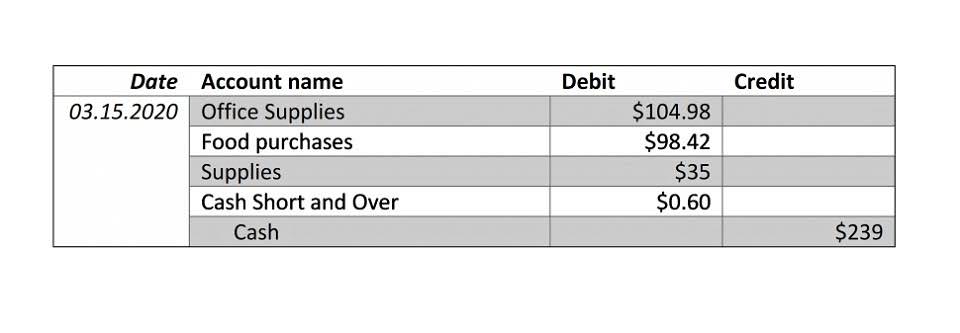
A series of cash overs and shorts may be a sign of theft or other problems in the company. As mentioned above, the sales staff or cashier can give too much or too little change to the customer. This difference is treated as income how to find cash over and short or expense and presented in the income statement. When we give too much change to customers, it means that we make change more than it should be. The cash over and short account is an excellent tool for tracking down fraud situations, especially when tracked at the sub-account level for specific cash registers, petty cash boxes, and so forth. An examination of the account at this level of detail may show an ongoing pattern of low-level cash theft, which management can act upon.

how to find cash over and short

Indirect Method vs. Direct Method

how to find cash over and short

In the example, if your petty cash account’s original balance was $1,000, subtract $550 from $1,000 to get $450, which is the amount by which you need https://www.bookstime.com/ to replenish the account. Essentially, an increase in an asset account, such as accounts receivable, means that revenue has been recorded that has not actually been received in cash. On the other hand, an increase in a liability account, such as accounts payable, means that an expense has been recorded for which cash has not yet been paid. Investors examine a company’s cash flow from operating activities, within the cash flow statement, to determine where a company is getting its money from.

Over and Short: Definition and What It Means in Accounting

After almost a decade of experience in public accounting, he created MyAccountingCourse.com to help people learn accounting & finance, pass the CPA exam, and start their career. For the past 52 years, Harold Averkamp (CPA, MBA) hasworked as an accounting supervisor, manager, consultant, university instructor, and innovator in teaching accounting online. The account Cash Short and Over provides a way to monitor employees’ cash handling proficiency. For the past 52 years, Harold Averkamp (CPA, MBA) has worked as an accounting supervisor, manager, consultant, university instructor, and innovator in teaching accounting online.

  • If its balance is on the debit side, it is usually presented in the miscellaneous expenses.
  • In the long run, if the company has to remain solvent at the net level, cash flow from operations needs to remain net positive (in other words, operations must generate positive cash inflows).
  • The reconciliation report is used to check the accuracy of the cash from operating activities, and it is similar to the indirect method.
  • In addition, any changes in balance sheet accounts are also added to or subtracted from the net income to account for the overall cash flow.
  • It’s “other revenue” for you, not a normal source of revenue like your paycheck.
  • Inaccuracies in this stage may be due to rushed counts, distractions, or simple miscounts.

If the company is not generating money from core operations, it will cease to exist in a few years. The main reason why a company exists is to earn revenue and create shareholder revenue. This is the prime reason why assessing whether the company has been able to generate cash by operating activities is an important component. As from above, we can see that Apple Incorporation in FY15 has generated $81,7 billion as cash from operating activities, of which $53,394 billion has been generated as Net income. ABC Corporation’s income statement sales were $650,000; gross profit of $350,000; selling and administrative costs of $140,000; and income taxes of $40,000.

  • It’s an “other expense” for you, not a normal expense like paying your bills.
  • He has been a manager and an auditor with Deloitte, a big 4 accountancy firm, and holds a degree from Loughborough University.
  • Shaun Conrad is a Certified Public Accountant and CPA exam expert with a passion for teaching.
  • They may also provide recommendations for enhancing procedures to mitigate future occurrences.

Recurring issues may prompt a deeper evaluation of company practices and employee training programs. The insights gained from audit reports can drive strategic improvements in cash management protocols, ultimately strengthening the company’s financial foundation. Businesses can forecast cash into any category or entity on a daily, weekly, and monthly basis with up to 95% accuracy, perform what-if scenarios, and compare actuals vs. forecasted cash. Features like this help manage general ledger posting rules for bank transactions.

how to find cash over and short

how to find cash over and short

In contrast to investing and financing activities which may be one-time or sporadic revenue, the operating activities are core to the business and are recurring in nature. Most retailers’ accounting systems have a https://www.facebook.com/BooksTimeInc/ cash over short account setup because they generally deal with cash sales everyday. In this case one balance sheet asset (cash), has been increased by 1,414 when the cash is banked. A firm should note instances of cash variances in a single, easily accessible account.

Categories
Bookkeeping

Financial Statements: List of Types and How to Read Them

bank income statement example

Some candidates may qualify for scholarships or financial aid, which will be credited against the Program Fee once eligibility is determined. As you can see at the top, the reporting period is for the year that ended on Sept. 28, 2019. This includes local, state, and federal taxes, as well as any payroll taxes.

Submit to get your retirement-readiness report.

  • An income statement is a vital tool in financial reporting and one of the most common and critical statements you’re likely to encounter.
  • A multi step income statement is often used to make GAAP financial statements.
  • The accords stipulate minimum capital requirements, leverage ratios, and liquidity requirements that banks must meet.
  • When you depreciate assets, you can plan how much money is written off each year, giving you more control over your finances.
  • You can use this information to make financial projections and more informed decisions about your business.
  • Note that when we are creating an income statement, we only take the incomes and expenses from the trial balance – we ignore everything else (assets, liabilities and owners equity).
  • In the income statement, expenses are costs incurred by a business to generate revenue.

The income statement serves as a tool to understand the profitability of your business. The income statement can also help you make decisions about your spending and overall management of business operations. Income statements should be generated quarterly and annually to provide visibility throughout bank income statement example the year. Loans to customers are considered assets because this is the core method by which a bank earns money. They store customer deposits, sometimes paying out a small interest rate, and then lend out a percentage of those deposits to other customers in the form of loans, charging a higher interest rate. Conversely, under liabilities, the customer deposits are not owned by the bank and have to be paid out to the customers upon request.

Step 2 of 3

  • Financial statements can also be compared between competitors in the same industry to see the differences in their business operations and profits.
  • It is used to ascertain the health of a business entity at a particular moment.
  • HBS Online’s CORe and CLIMB programs require the completion of a brief application.
  • To calculate interest charges, you must first understand how much money you owe and the interest rate being charged.
  • Please review the Program Policies page for more details on refunds and deferrals.

These securities are assets and expected to increase in value, if they decrease in value, they may become trading liabilities. Investors can monitor loan growth to determine whether a bank is increasing its loans and using bank deposits to earn a favorable yield. Although a liability on a bank’s balance sheet, deposits are critical to the bank’s lending ability. Amanda Bellucco-Chatham is an editor, writer, and fact-checker with years of experience researching personal finance topics.

bank income statement example

How to read and prepare a single-step income statement

bank income statement example

Banks invest those funds in securities or extend loans to companies and consumers. When the interest a bank earns from loans exceeds the interest paid on deposits, it https://www.facebook.com/BooksTimeInc/ generates income from the interest rate spread. The Board of Directors will receive a financial statement package, including the (multi-step) income statement, that includes analysis and interpretations of trends by the financial analyst team and the company’s CFO. Budgeted income statements can also be drawn up, showing targeted figures for sales, expenses and profits.

bank income statement example

Together, these provide the company’s net income for the accounting period. Primary revenue and expenses offer insights into how well the company’s core business is performing. Secondary revenue and fees, on the other hand, account for the company’s involvement and expertise in managing ad hoc, non-core activities.

bank income statement example

  • An income statement is an important financial report that provides rich information on how a business or company is doing and how it’s likely to perform in the future.
  • We confirm enrollment eligibility within one week of your application for CORe and three weeks for CLIMB.
  • However, taking the time to understand financial statements, such as learning how to read an income statement, can go far in helping you advance your career.
  • All participants must be at least 18 years of age, proficient in English, and committed to learning and engaging with fellow participants throughout the program.
  • As you start preparing income statements, here are three factors to consider to make the process easier and ensure accuracy.

This fundamental difference in operations results in the difference of a bank’s financial statements from those of nonfinancial entities. An example of a single step income statement is Dana Incorporated’s Consolidated Statement of Operations for the calendar years ended December 31, 2021, 2020, and 2019. It’s available as a 10-K company filing in the SEC’s EDGAR database dated February 23, 2022. The purpose of an income statement is to show the profits and losses a company made over a specified period of time. It is used to ascertain the health of a business entity at a particular moment. Together with the Balance Sheet and Cash Flow Statement, it is included in every company’s Annual https://www.bookstime.com/articles/bookkeeping-for-landscaping-business Report – the publicly available, comprehensive overview of a business’ health and financial standing.

Categories
Bookkeeping

The Ultimate Accounts Payable Guide: Definition, Examples & Automation

accounts payable management

AP teams often find themselves running flat out trying to process invoices, obtain approvals, and get vendors paid on time. And although they are being asked to take on more strategic roles, finding the time to take on those new responsibilities can be challenging. For many CFOs this means extending payables as long as possible https://novator.team/post/39 to ensure maximal cash flow. As a result, suppliers may slow delivery times, be less willing to respond to queries or concerns, and insist on more stringent payment terms. Although some people use the phrases “accounts payable” and “trade payables” interchangeably, the phrases refer to similar but slightly different situations.

  • In response to the need to optimize, many companies delay payments.
  • Someone on our team will connect you with a financial professional in our network holding the correct designation and expertise.
  • Having a robust process in place helps the correct and timely payment of bills.
  • Breaking down silos and promoting cross-functional cooperation will be crucial for a seamless flow of information.
  • Many readers tell us they would have paid consultants for the advice in these articles.

What are the Best Practices to Know for Accounts Payables?

accounts payable management

Before the order is placed, the plant manager must complete a PO, which lists the machinery’s price and other details. Balance sheet accounts are separated into current and noncurrent accounts. When you sign up for Centime you’ll be assigned a Customer Success https://4stor.ru/user/ykummgLog/ Manager who is dedicated to helping you get the most out of Centime. Our Customer Success team is based in the USA and available Monday through Friday from 8am to 6pm Eastern Time. QuickBooks has what you need to manage your money, all in one place.

  • Businesses that automate their accounts payable processes gain significant advantages beyond optimizing manual paper-based processes.
  • While change may pose challenges, embracing a strategic approach to account payables management promises substantial benefits and a healthier bottom line.
  • Businesses also often have bills from overseas suppliers in foreign currencies.
  • It also ensures you have enough cash flow to meet your other financial obligations.
  • Accounts payable automation is an excellent technique for companies to enhance their accounting, provided that they know how to adopt and use the technology.

Are Accounts Payable Treated as Business Expenses?

So, just like you wouldn’t want to run out of gas on a long road trip, it’s important to keep your accounts payable system well-oiled and running smoothly to keep your business moving forward. Depending on the degree of payable automation, you may be able to scan invoices electronically, resolve disputes, and track delivery receipts. Once it’s approved, the invoice is ready to be paid, preferably using an electronic payment system. We believe everyone should be able to make financial decisions with confidence. This team of experts helps Finance Strategists maintain the highest level of accuracy and professionalism possible. At Finance Strategists, we partner with financial experts to ensure the accuracy of our financial content.

Step 2: Review the invoice

accounts payable management

The articles and research support materials available on this site are educational and are not intended to be investment or tax advice. All such information is provided solely for https://whoiswho.com.ua/ru/2021/05/samye-strannye-idiomy/ convenience purposes only and all users thereof should be guided accordingly. The Accounting Department of a company typically manages and oversees Accounts Payable activities.

Accounts payable management is the process of managing business debts owed to vendors and suppliers for purchases made on credit. With companies scaling rapidly, the volume of invoices their AP teams have to process also increases drastically. Even after increasing headcount, invoice inventory and vendor master management can become burdensome. Scaling often also requires upgrading to new software that might take weeks or months to implement. With the ability to pay bills in more than 145 currencies across more than 200 countries, Airbase is a strong accounts payable software solution for businesses with international vendors.

Table of Contents

accounts payable management

What is an Accounts Payable Invoice?

  • Typical payables items include supplier invoices, legal fees, contractor payments, and so on.
  • It’s better to take a more strategic approach to managing working capital.
  • AP automation offers enhanced reporting, providing insights into payment statuses, outstanding balances, early-payment discounts, and vendor performance in real time.
  • Moreover, the improved efficiency in payment procedures provides opportunities to negotiate beneficial terms with suppliers, including risk-sharing, flexible payment terms, and early payment discounts.
  • Consider investing in automated AP and payment processing solutions that provide real-time visibility into your P2P processing.